



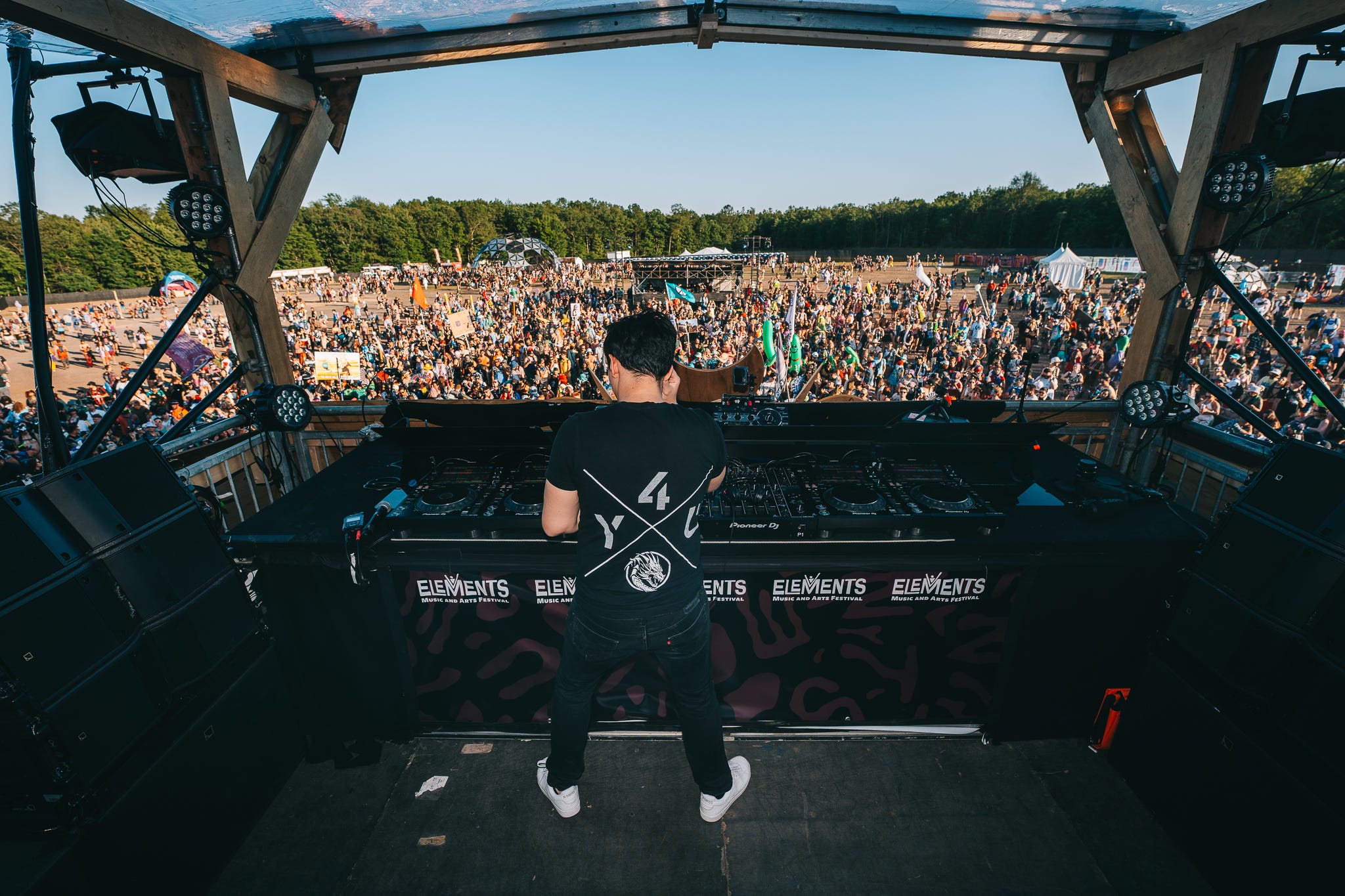
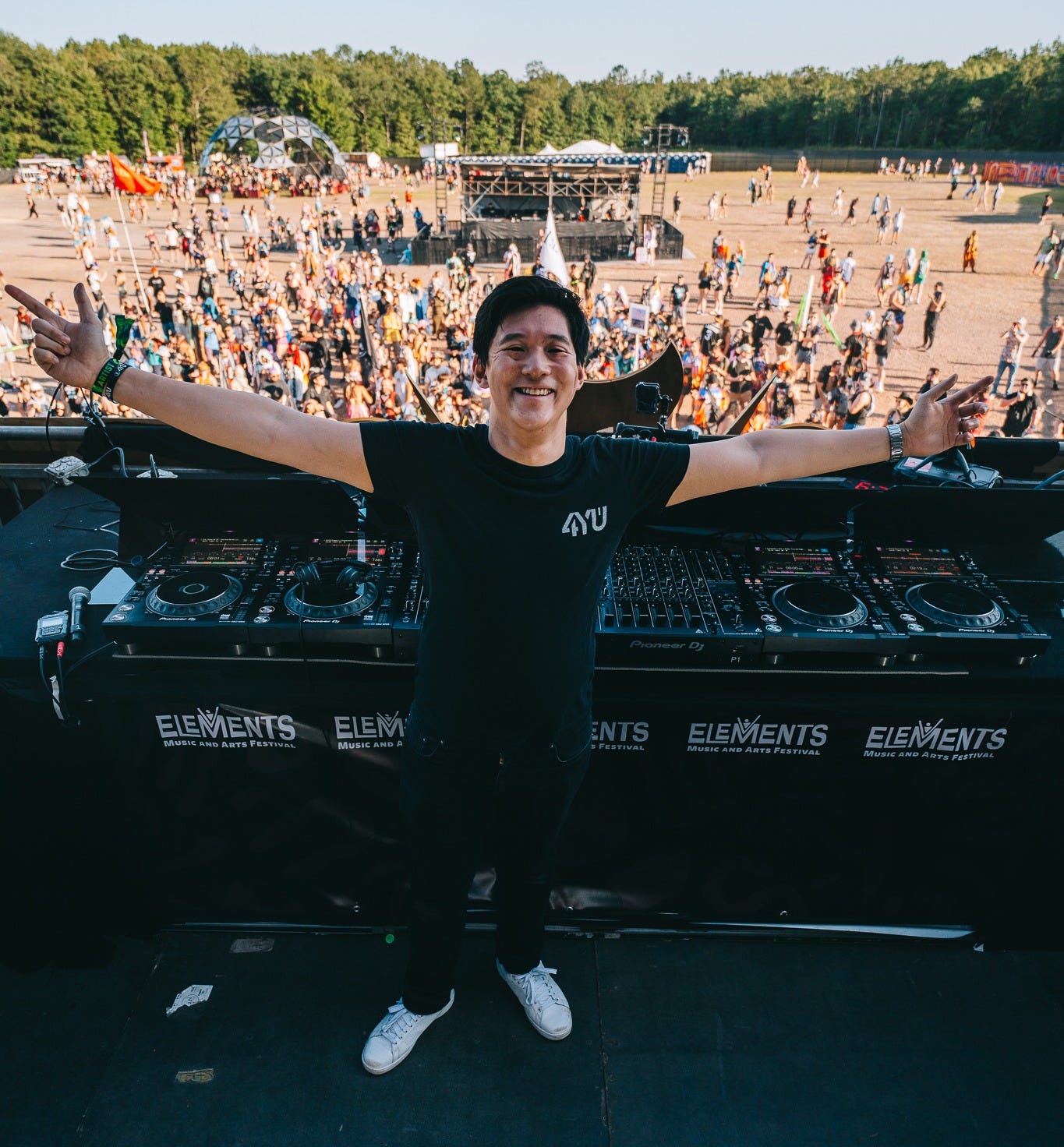
From a humble die-hard Hardwell fan to a festival-headlining trance artist, New York native Gabriel Uy has reached the stars from the ground up. Better known as 4YÛ, Uy has traversed the local warehouses in NYC, peddled banger songs at mainstay Asian nightlife clubs, and is now playing the biggest festivals throughout the world. With Dreamstate, Tomorrowland, and Elements Music Festival under his belt, 4YÛ is working hard to deliver his unique and unifying sound, dedicated to the hearts and ears of travelling sidequesters and die-hard trance fans alike.
Hot Cue Magazine sat down with 4YÛ to discuss his long journey to stardom. Learning production from YouTube, finding community amongst music lovers, and befriending his long-time idols are only some of the stories that 4YÛ has to share.
Get to Know 4YÛ
What’s your name?
4YÛ: My name is Gabriel Uy. I live in Flushing right now, and I’m 31 years old. I started DJing in my bedroom in 2016 and playing actual gigs in 2019.
What was your first gig like?
4YÛ: My first time playing live was at my best friend’s birthday party, but my actual first gig in front of people I don’t know was actually in Amsterdam. It was crazy because I went to see one of my favorite artists, Outrage, and now he’s my close friend.
His USB didn’t work actually [at the gig], so we looked at each other and I was like, yo, my USB works. We asked his manager if we could go back to back and he was like yeah, why not? It was like a 45 minute setup, just us throwing music and having fun. It was great.
What genres do you mostly play?
4YÛ: I mostly mix and produce techno and trance. I used to have another name called DJ Guy, which I used to produce Big Room and Progressive House and a few other genres. But times are changing. After COVID, everything about DJing became a lot faster, and a lot harder. So I went the different direction of techno and trance, which I [produce] right now. I love it so far.
What were some of your greatest or most memorable gigs?
4YÛ: Wow. So my most memorable gig was Dreamstate since I’m a trancehead. I won [Insomniac’s DJ/producer competition] Discovery Project; one of the guys that plays my music, Giuseppe Ottobiani, was the judge. The first track I put [in my submission] was [his song], and he picked me to play Dreamstate last year.
I was probably the happiest because I was able to play my own music. In New York, I would have to play either Tech House or bigger music from 10 years ago that I still love, but don’t want to play live. But Dreamstate was actually one of the first few gigs I was able to play the entire 4YÛ set, no questions asked.


4YÛ’s Musical Process
How did you get into DJing?
4YÛ: I used to rave starting in 2013. My first rave was Electric Zoo funnily enough – RIP Electric Zoo. But in 2016, I saw Hardwell play at EDC New York, and everyone was following along to everything he said on the mic. We were jumping, clapping, whatever he said. It was crazy. I got really inspired by that [...] to start DJing.
I did a lot of research at first, but I mostly trusted my ears. I went to the Guitar Center almost every day after school just to DJ. I would suck so bad, but I didn’t care because I was having fun.
What’s your favorite part about producing?
4YÛ: My favorite part of producing is me imagining the song I [play], on the main stage of whatever festival. Like my song got played at Tomorrowland [and] it was probably the happiest moment of my life besides my marriage. I was really happy, like I was shocked. My friends were like, B.Jones just played your track at Tomorrowland! I did not believe it. I became friends with her [after that], so now we’re trying to make a track together.
How do you think DJing and producing are different from each other?
4YÛ: Everybody can DJ. DJing music is a lot easier because I can literally teach you in like three, four hours on what to do, how to transition. But producing – I can teach you some stuff, but I cannot teach you how to find your own signature sound.
For DJing, I can literally play a full hour set of straight bangers and everybody will have fun, but you’re just a Spotify playlist at that point. I can literally put Martin Garrix’s entire Tomorrowland set as my set. That’s not even actual DJing [though].... DJing is trying to find a song that you like and bringing it out to a crowd they don’t know if they’ll like.
Has there been any challenges in this scene as an independent DJ?
4YÛ: I’m still coming up in the scene. I’m not established. So many things are hard because it’s not a set schedule like a 9-5 job.
With producing music and DJing, it’s just a battle of trying to make yourself motivated. You’re your own boss. I have to find the right people. I have to find the right sounds. And that’s not what a lot of people tell you about DJing and producing, just because they see the glamorous things about it.
As an [independent] Asian DJ, I’m still considered a local DJ, which is fine. Here in New York, I have to sell tickets, tables, and create a lot of social media content for it and it’s hard to get paid. But for a festival, I get treated as an artist. I’m getting a guest list, I’m paid properly, and I get transported. In the city, whatever, I’m taking the subway and Uber.
What kind of advice do you have for people starting out?
4YÛ: Just be hungry honestly. In the beginning, it’ll be great if you just YouTube whatever, like how to DJ [...] there’s a million videos. Replicate it, and if you want to learn how to produce, do the same thing. Watch the video and literally copy it [...] and remake your favorite songs. You’ll literally hear what they do and [think] wow, that’s so simple. I thought [producing] was harder than [it was] and you’re just mindblown because of how simple it could be. Take your production level ten times longer, ten times more further than needed because you’ll know how to make your favorite song and you’ll realize how easy it is.
On Identity
It must be a little different because you’re a DJ, but you’ve also been a long time raver. What’s your perspective on Asian rave culture?
4YÛ: Kandi trading, head banging, raving, sidequesting. It’s all fun, that’s all part of the experience of raving. If you’re just there to listen to music, it’s fine, but sidequesting: finding new stages, finding new things at a festival you wouldn’t have found if you were just in your group the entire time. If you sidequest, you can find a DJ that you’ve never heard in your entire life.
I guess the Asian raving scene’s changed a bit in New York since I started raving. The music changed: when I first started raving, big-room progressive house was very big and I was part of [that] golden era of EDM. Now it’s like the golden era part two because all the DJs and songs from back then–80s, 90s, early 2000s–are coming back in a new, faster form. Music comes in cycles: the scene itself hasn’t changed much, [but] the music has changed.
You don’t think the popularity of raving within Asian American communities has risen?
4YÛ: It definitely has risen exponentially, don’t get me wrong. But that’s everything. Music will always hit you as a person, no matter what ethnicity you are. For example, with Hardwell, I was in a very dark place when I found his music. Then one of my bosses was like, hey, do you want to come to the show? And I saw Hardwell. The first song that came on when I walked into the show was Apollo. The lyrics from that song triggered me and I became a fan of his, then a fan of raving.
Having fun and enjoying the moment: that’s the healing property of music. In a political space, Taiwan and China hate each other. But literally at EDC, you see a Chinese flag and a Taiwanese flag not even 10, 15 feet away from each other. There’s a sense of unity within the Asian community.
Do you feel your Asian-American identity has influenced you as an artist?
4YÛ: I would say it definitely helped me because most of the DJs you see in my genre are European–actually, like ninety percent of the DJs are European. There are the Dutch, Swedish, people from the UK, or any other country, and there’s less represented Asian artists out there. Like in China, a lot of Asian DJs are ghost-produced by other people, so their music isn’t their music. I’m trying to change that narrative. I create my own music and I’m actually DJing.
I feel like we haven’t seen a lot of DJs that are either Asian or have Asian influences in their music.
4YÛ: Even though the culture is huge, it’s just harder because of how we grew up. Asian DJs just started getting into the scene. The first one I can think of is Laidback Luke. He’s half-Filipino and half-Dutch and he’s been in the scene since the 90s and early 2000s. A lot of Asian DJs are very recent even though they started around the 2013 era where the Dutch literally dominated. It’s just a very long process. For example, Illenium got started in 2011 and didn’t get big until 2017. ARMNHMR’s been producing since 2008 but they didn’t get big until 2020, around COVID.
Behind the Scenes
Who would you say you make music and perform for?
4YÛ: Honestly, everybody. Because music is very global. It doesn’t have a specific race or a specific country or continent. For my music, I create for everybody to listen to. Throw it in a playlist, or I can play for the club or for the festival. It’s for dancing and partying or for when you need to move around.
Have you had any crazy or cool moments as a fan yourself?
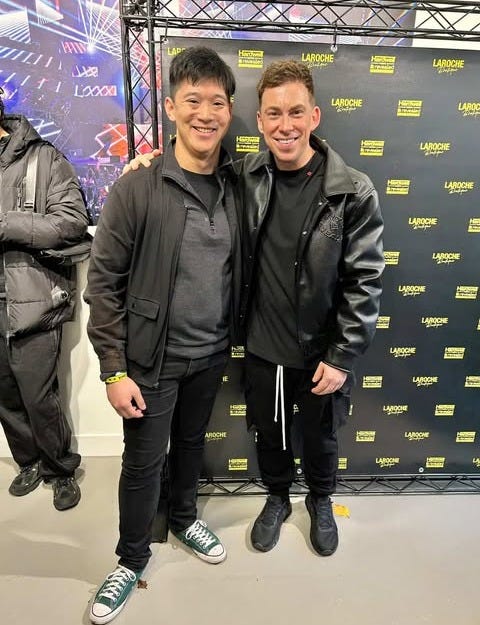
4YÛ: 100%! I’ve opened for Tiësto and Hardwell, literally my GOAT. He’s the one that got me out of being suicidal back in 2013. He’s the one that made me start DJing and producing music. When I met him in 2013, I was so happy. I posted it on my story and everybody was like, you made it, because they know my story. I pretty much met my god in their eyes. After that, I followed him in 2023 for like five shows. Before EDC Las Vegas, we had a little 10 minute conversation, he thanked me for coming to the shows. I changed my Instagram profile pic too. I met him again in 2024 and he was like, how’ve you been, long time no see. We had a normal conversation. Now it’s like, oh that’s my best friend. It’s pretty cool, that transition.
From initial scene to now, how have you changed as an artist?
4YÛ: The funny thing is that my initial scene was Marquee because all the big DJs used to play there. I got into Mission as a clubber in 2019 because Laidback Luke was there and I’m his kung-fu student. Like, I literally do kung-fu with him. Then in 2021, one of my friends, [who] was a DJ for Shemanski and had opened for MARION, Porter Robinson, Skrillex, [...] gave me the footing to start DJing. I got on the Mission lineup and was eventually asked to be a resident.
But starting in 2023, I started changing gears because I didn’t want to play all the bangers anymore, I wanted to play my own stuff. That’s when I ended my residency at Mission because our music changed. Honestly, I was sad at first because it was my home for the past two and a half years. But now I made a name for myself.
Even though I play a lot less gigs than I used to play while being a resident DJ at Mission, I’m playing a lot more meaningful gigs.
Check out 4YÛ on your music streaming platforms and social media (@4yu.music on Instagram), where you can find his up-and-coming shows and latest hooliganery. Don’t forget to listen to his newest single, In My Veins, with Franny J.
And for more artist interviews + all things related to the NYC electronic scene, subscribe to Hot Cue Magazine below.
Be hungry!!